pcb assembly

What is a Flexible Printed Circuit Board (PCB)?

OPTIMIZATION OF POLYMERIC STRUCTURE OF ORGANIC PRINTED CIRCUIT BOARDS (PCB)

POLYMERIC STRUCTURE OF MULTILAYER FLEXIBLE PRINTED CIRCUIT BOARDS – ”Sulaiman Khalifeh, in Polymers in Organic Electronics, 2020

The polymeric printed circuit boards (also called “organic printed circuit boards”) PCB are the simplest self-assembled structures of interconnected microelectronic/Nano-electronic components on a thin film substrate formed from polymer-based composites such as epoxy. As illustrated in Figure 5.1, such structure has several advantages, including very low cost, good electromechanical properties, easy to manufacture in any shape, and applicable for multilayer configurations. These printed circuit boards can be electrically connected to organic/polymeric circuits by either “through-hole technology” THT (older process) or “surface mount technology” SMT (newer process). A more recent solution includes “integrated circuits” IC (also called “microchip”) by which the polymeric printed circuit boards can be built with more circuits and components that are electro-chemically grown in place on the surface of a very small chip. The other method is called a “hybrid circuit” that contains some components, which can be grown onto the surface of the substrate without the need to be mounted on the surface and soldered.
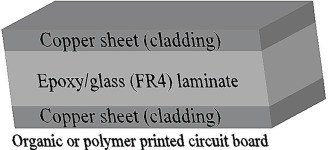
Figure 5.1 Structure of organic/polymeric printed circuit boards.

Three-dimensional polymeric printed circuit boards 3D-PCPs are the most developed solutions, where both single-sided or multilayered polymeric printed circuit boards can be fabricated in the form of 3D-prototypes depending on the “miniature technologies” such as “molded interconnect device” MID. With molded interconnect device technology, the copper traces act as an electrical circuit on the polymeric substrate that can be fabricated by “two-component injection molding,” “hot stamping, photolithography,” “in-mold circuit film,” or “laser direct structuring” LDS which can be considered as the most flexible technology. Such a process can be called “three-dimensional molding of interconnected devices” 3D-MID, while the resultant product can be called “three-dimensional printed circuit board” 3D-PCB as illustrated in Figure 5.2. The direct laser structuring can be achieved immediately after applying single-component injection molding of the carrier. Examples of polymers used for fabricating the polymeric substrates by injection molding process include: liquid crystal polymers LCP, poly(butylene terephthalate) PBT, Trogamid® (amorphous polyamide) (known as: PA 6-3-T), and poly(ethylene terephthalate)/poly(butylene terephthalate) blend PET/PBT.
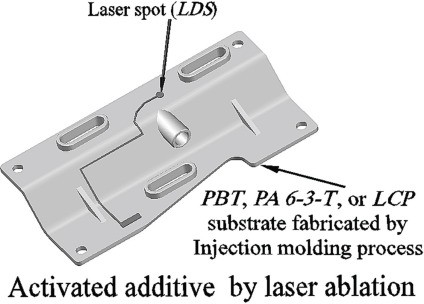
Figure 5.2. Three-dimensional molded integrated device 3D-MID.

[Data from Laser Micronics GmbH, 3-Dimensional Circuitry, Laser Direct Structuring Technology (LPKF-LDSTM) for Molded Interconnect Devices, 2012.]Copyright © 2012.

The concept of “optoelectronic printed circuit boards” has been developed to satisfy the increasing demand for high data rates along with progressive miniaturization of devices and components. Optoelectronic printed circuit board represents the integration of optics in a polymeric printed circuit board that is the need to utilize optical fibers, the generation of waveguides by UV lithography, embossing, or direct laser writing. An example of commercial polymers used for structuring optoelectronic printed circuit boards is Ormocer®, which is a type of inorganic/organic hybrid polymer.

POLYMERS FOR CONVENTIONAL PRINTED CIRCUIT BOARDS

The main function of printed wiring is to support circuit components and interconnect these components electrically. Several types of flexible and rigid printed wiring have been used, including traditionally printed circuit boards (single-sided, double-sided, and multilayered), ultra-multilayered printed circuit boards, and three-dimensional printed circuit boards. These types are based on variable dielectric materials (polymers and composites, conductors types, number of conductor planes, rigidity, flexibility, etc.) Rigid printed circuit boards of substrates formed from thermosetting polymers, such as epoxy composites, and flexible printed circuit boards of substrates formed from thermoplastic polymers (such as polyethylene terephthalate PET) are the main two types. Thermosetting composites can be used in the form of filled or glass fiber reinforced epoxy resin EP-GFR, while paper reinforced phenolic (phenol-formaldehyde PF) resin with a bonded copper foil or silicone Q substrates is used for fabricating very small chips (microchips) and stretchable circuits.

The first optimized type of glass fiber reinforced epoxy resin used for structuring conventional printed circuit boards is available in the form of epoxy glass, fire-retardant grade-4 (abbreviated as FR-4). It has very high thermal stability, good mechanical and electrical properties, flame retardance, excellent bonding to copper foil, electroless copper, and glass fibers. It is approved by National Electrical Manufacturers Association NEMA for synthetic resin bonded papers. FR-4 is a polymeric composite material made of woven glass impregnated with plasticized epoxy resin. The second optimized resin is phenolic glass, fire-retardant grade-2 (abbreviated as FR-2), which is a composite material made of paper impregnated with plasticized phenol-formaldehyde resin for the same application. The third optimized type is silicone, which has been used as a flexible substrate for fabricating hybrid stretchable circuits (Figure 5.3). It consists of a millimeter thick polydimethylsiloxane PDMS (IUPAC name: polydimethylsiloxane) having the formula ((C2H6OSi)n) within which two concentric discs of polyimide PI foil (50 µm thick) are embedded. It is a derivative of polyorganosiloxane used as packaging polymer for electronic devices, as well. Polydimethylsiloxane is the first optimized derivative of silicone family used for structuring polymeric double-disk stretchable substrate due to its high strain property. Note: polymeric materials used for fabricating printed circuit board substrates are made of differential dielectrics. This means that they can be selected to provide different insulating values depending on the requirements of the circuit. For this reason, the two types of substrate that can be selected for traditional printed circuit boards are dielectric printed circuit boards and prepreg printed circuit boards.
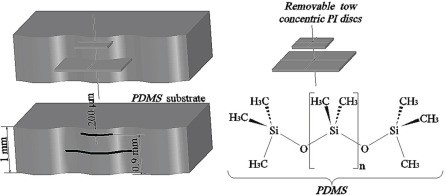
Figure 5.3. A representation of the polymeric double-disk stretchable substrate.

DIELECTRIC SUBSTRATE-BASED POLYMERIC PRINTED CIRCUIT BOARDS

The dielectric materials (including most polymers) are insulators (non-conducting electricity) resisting the flow of an electrical current. Dielectric polymer represents the optimized class of dielectric materials used for dielectric substrate-based polymeric printed circuit boards, including polytetrafluoroethylene PTFE, epoxy glass, fire-retardant grade-4 (FR-4), epoxy glass, fire-retardant grade-1 (FR-1), composites of epoxy with cotton paper (CEM-1), and composed of nonwoven glass core combined with epoxy resins (CEM-3). The laminates of thermoplastic polymer polytetrafluoroethylene represent the first member of dielectric polymers used for antennas and base stations because of their high melt viscosity. The laminates are fabricated under the lamination pressure of 3.1-3.27 MPa.

An example of commercial polytetrafluoroethylene grade used as a polymer for structuring the substrate of double-sided printed circuits is Teflon®. Figure 5.4 is an example of multilayer laminate containing polytetrafluoroethylene used for printed circuit boards. Polytetrafluoroethylene is bonded with chloro-trifluoroethylene CTFE (IUPAC name: 1-chloro-1,2,2-trifluoroethene) having formula C2ClF3 or fluorinated ethylene-propylene copolymer FEP produced by free-radical polymerization of mixture of hexafluoropropylene and tetrafluoroethylene.
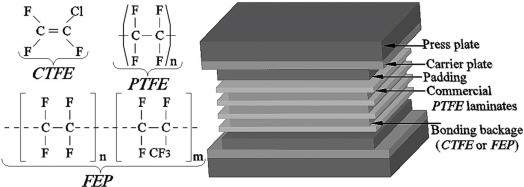
Figure 5.4. Example of multilayer laminate containing polytetrafluoroethylene for printed circuit boards.

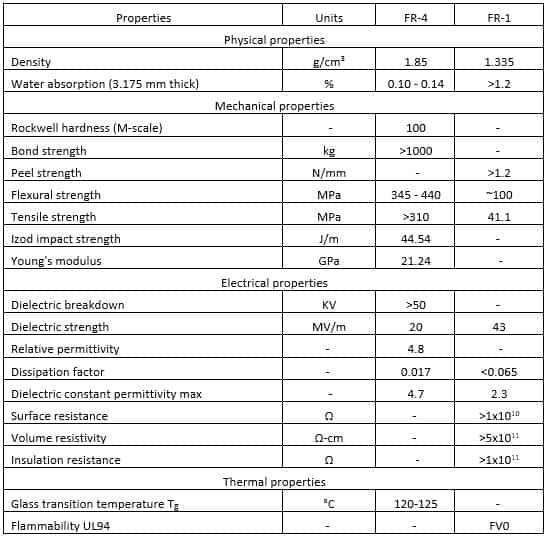
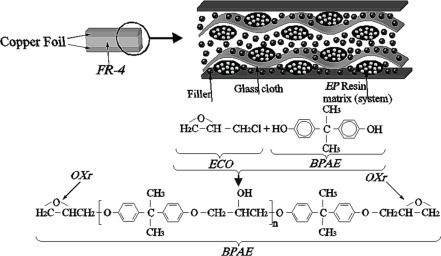
Epoxy glass, fire-retardant grade-4 FR-4 is the second optimized grade for structuring dielectric substrate-based polymeric printed circuit boards due to its very good mechanical and electrical properties, ability to resist flame, and excellent bonding to copper foil, electroless copper, and glass fibers. Epoxy is available as “difunctional-epoxy” DfEP blend formed by reacting epichlorohydrin and bisphenol-A with flame-retardant additive, “tetrafunctional epoxy” TfEP blend, and “multifunctional epoxy” MfEP blend, listed in Table 5.1. Importance of epoxy polymer is in acting as self-extinguishing binder (self-extinguishing term is used to describe the ability of a material/polymer to cease burning upon removal of the source of flame). Epoxy glass, fire-retardant grade-4 available in the form of laminate is resistant to high temperature and water absorption\, has good electrical insulation, and good machinability. To optimize both physical and electrical properties of the laminate, its glass fibers should be made perpendicular to one another. Some of these properties are listed in Table 5.2. An example of epoxy glass, fire-retardant grade-4 (FR-4) two-layer structure is illustrated in Figure 5.5. Such structure consists of a woven glass fiber mesh soaked in the organic polymer (epoxy as resin matrix) with copper layers laminated (sometimes filled with specific materials).

Properties Units (condition)Difunctional epoxy DfEP blendTetrafunctional epoxy TfEP blendMultifunctional epoxy MfEP blend
Glass Transition Temperature°C130130 – 140160 – 190
Dielectric constantat 1MHz4.54.64.4
Dissipation factorat 1 MHz0.0250.0250.025
Moisture absorption%0.700.06 – 0.0130.60 – 0.013
Table 5.1. Optimized epoxy types for dielectric substrate-based polymeric printed circuit boards.
Table 5.2. The general properties of epoxy glass, fire-retardant grade-4 (FR-4) and epoxy glass, fire-retardant grade-1 (FR-1).
Figure 5.5. Example of two-layer structure of epoxy glass, fire-retardant grade-4 (FR-4).

According to Figure 5.5, and Table 5.1, the polymeric matrix of epoxy glass, fire-retardant grade-4 FR-4 laminates consists of bi-, tetra- or multi-functional epoxy groups. Note: epoxy EP is chemically derived from the reaction of bisphenol-A epoxy BPAE with epichlorohydrin ECO which creates diglycidyl ether of bisphenol A (DGEBA) (also referred to as oxirane OXr). OXr (DGEBA) reacts in subsequent resin polymerization, curing the polymeric matrix. Higher crosslinking in the cured system can be achieved by the use of epoxy monomers with more than two epoxy functional groups per molecule.

Epoxy glass, fire-retardant grade-1 FR-1 is the second optimized epoxy glass, fire-retardant grade used in dielectric substrate-based polymeric printed circuit boards. It is a thermoset polymeric composite formed from the paper base with plasticized epoxy resin. Properties of this composite were listed in Table 5.2. Composite of epoxy with cotton paper (abbreviated as CEM) represents the third optimized class of polymeric composites used for structuring dielectric substrate-based polymeric printed circuit boards. These composites are commercially available in the form of five numbered grades, including CEM-1, CEM-2, CEM-3, CEM-4, and CEM-5. Where numbers from 1 to 5 are related to the type of the base. For example, number 1 means cotton (or cellulose) paper and epoxy.

CEM-1 is a polymeric composite consisting of woven glass fabric surfaces and paper core combined with epoxy resin. It is easy to punch, and has excellent mechanical and electrical properties, and higher flexural strength than paper-based grades. It is used in radio receivers, smoke detectors, and single-sided printed circuit boards. Its properties are listed in Table 5.3. CEM-3 is a composite of nonwoven glass core combined with epoxy resin. Similarly to CEM-1, it consists of epoxy resin with woven glass cloth surfaces, but its core is nonwoven matte fiberglass. The nonwoven mate fiberglass optimizes through-hole plating. It has better fine-line capability than FR-4. It has a very smooth surface and milky white color. It can be used as an alternative to FR-4, known as a flame retardant epoxy copper-clad plate glass material.
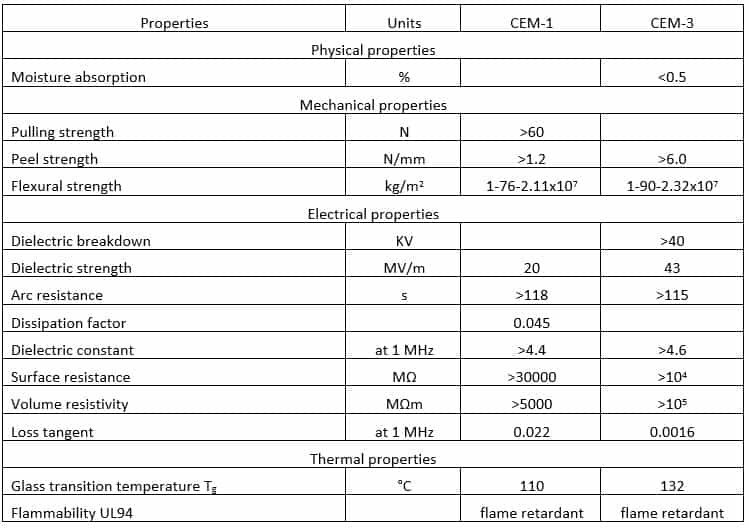
Table 5.3. The general properties of composites of epoxy with cotton paper CEM-1 and composites of non-woven glass core combined with epoxy resin CEM-3.

What is a Flexible Printed Circuit Board (PCB)? Read More »
Why do we need Multilayer PCB?

The Advantages of Multilayer PCB

Having more layers means the board is thicker and, therefore, more durable than single-sided PCBs. This is another reason adding functionality through additional layers is preferable to increase the dimensions of a single layer. Printed circuit boards have ubiquitous presence today, what with them being the core of most electronic items. With the growing complexity of devices, Printed circuit boards are therefore increasingly becoming more complex. From flexible to odd shaped ones, there is a range of PCBS out there. While electronic devices with limited functions can do with single layer PCBs, there is an exponential growth in multi layered PCBs. By definition, multilayered PCB are made up of layers of double-sided circuit boards with heat protective insulation between them. The electrical connections between the layers happen through various kinds of vias resulting in complex multilayered PCBs. With complexity in applications, PCBs today can range anywhere from four to twelve layers.

  • Size: Multilayer PCB have an added advantage on account of their small size as they lend themselves well.
  • Lightweight: Small PCBs also come with reduced weight. This is particularly true also because single and double layered PCBs need a number of connectors that add to the weight and hence restrict mobility.
  • Reliability: Typically multilayered PCBs are high on reliability as well as of high quality.
  • Durability: Multilayer PCBs also come with high durability as they are able to withstand the heat and pressure that is applied on them.
  • Flexibility: For assemblies that use flexible construction techniques, a flexible multilayered PCB can be helpful particularly in applications that require some amount of bending.
  • Powerful: Multilayer PCBs typically are high density and have greater capacity as well as speed.
  • Single Connection Point: With single connection points, multilayered PCBs are beneficial for gadgets where size and weight are constraints.

On account of all these advantages, multilayer PCBs are the preferred option especially as greater functionality and reduced size increasingly become the norm.

All of this is not to say that multilayered PCB Fabrication does not have any disadvantages. Largely, compared to single layered PCBs, multilayered ones come with added cost as well as increased design time. Multi layered PCBs also necessitate that there be skilled designers who have a wide experience and hence can overcome issues related to crosstalk and impedance. In efficient design it can directly impact board functioning.  Also, multilayer boards require increased production time and hence a lower turnover rate.

However, it is their improved functionality that more than covers for the many disadvantages associated with multi layered boards. As far as their increased costs go, with the advancement of technology, the costs are only slated to decrease.

However, even while using multi layered PCBs it is important to ensure that as far as possible you go with an even number of layers as opposed to PCBs with odd number of layers. This is on account of many factors including but not limited to the cost efficiency:

Single layer PCBs are cost ineffective

The cost ineffectiveness of odd number of layers stems from the fact that the process of creating an odd layered PCB begins with creating an even layered PCB and then etching away the unwanted layer. As the process suggests, this leads to a lot of wastage which in turn lead to cost inefficiencies.

Warping

Other than the cost aspect, etching also results in warping of the layer. With one side having copper and the other side not having it, there are different cooling rates, thereby creating stress on the PCB.

Risk of over & under plating

What the etching also does is that it leaves the two sides (one with copper and one without), with different weights, thereby adding to the risk of under or over plating.

On account of all the above reasons, it isn’t advisable to have single layers unless there is a specific, compelling reason to do so.

Why do we need Multilayer PCB? Read More »

To Design a good PCB stack-up

The rules and standard for designing a good PCB stack-up

The rules and standards for designing a good stack-up are hundreds. Let’s just see a few:

  • Ground plane boards are better because they allow signal routing in a microstrip or strip-line configuration. It also significantly reduces the ground impedance and, therefore, the ground noise;
  • High speed signals should be “routed” on intermediate layers located between the various levels. In this way, ground planes can act as a shield and contain the radiation coming from the tracks at high speed;
  • The signal layers should be very close to each other, even in adjacent planes.
  • A signal layer must always be adjacent to a plane;
  • Multiple ground planes are very advantageous, since they lower the board’s ground impedance and reduce radiation in a common way;
  • The power and mass planes must be rigorously coupled together;

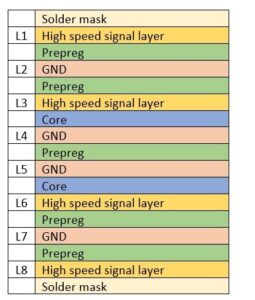
To achieve all these objectives, it is necessary to operate with a minimum of eight layers. Moreover:

  • From a mechanical point of view, it is advisable to implement a cross section to avoid deformations;
  • Configurations should be symmetric. For example, on an eight-layer PCB, if level 2 is a plane, level 7 should also be a plane;
  • If the signal levels are next to the levels of the plane (ground or power) the return current can flow on an adjacent plane reducing the inductance of the return path to a minimum;
  • To further improve noise and EMI performance, insulation between a signal layer and its adjacent plane can be made even thinner;
  • An important consideration to be made is the thickness of each signal layer. There are standard thicknesses together with the properties of different types of printed circuit material. When selecting the materials, it is advisable to consider their electrical, mechanical and thermal properties;
  • Use excellent software to help you design your stack-up. All this should be done in order to choose the correct materials from the library and perform impedance calculations based on the materials and their dimensions.

Careful PCB design is necessary

Proto-Electronics’ mission is to help you in this crucial prototyping phase by cutting your lead times. Online quotes in 10 minutes and delivery lead times starting from 5 working days will give you more peace of mind to work.

To Design a good PCB stack-up Read More »

Multilayer PCB stackup

Multilayer PCB Layer Stack-up

PCB Layer Stack-Up

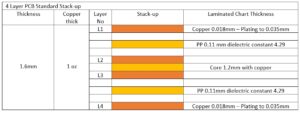
The single core is good for up to 4 layers of PCB, but for more layers like for 6 layers there should be 2 cores and for 8 layers there should be 3 cores. The layers are always taken in even numbers for the purpose of uniformity in layer stack.  

The multi-layer PCB is the combination of two or more single- or double-sided PCBs hence a strong mutual connection is in between. The increasing complexity of multilayer PCB gives rise to some typical issues that are noise, signal interference, cross talk, stray capacitances and impedance mismatches. These issues need to be professionally handled otherwise the overall PCB performance and reliability can greatly shatter.

A properly designed layer stack up can help reduce circuit’s vulnerability to Electromagnetic Interference (EMI) and external noises that can distort high speed signals. A good layer stack up also helps to avoid cross talks, improves signal integrity and impedance matching can reduce power losses. The perfect layer stack can also reduce the cost of manufacturing multilayer PCB.

The multilayer stack up will enable you to place more circuitry in the limited space while diverting your routing to internal signal layers by means of blind and buried via. Separate ground GND and power PWR planes are used which are also copper layers.

The layer stack up should be symmetrical and the minimum clearance between traces, layers spacing, and the thickness of core should be carefully taken. The thickness of the core can be from 0.1mm to 0.3mm.

The base substrate core material FR-4 is pre-impregnated with epoxy resin system. The pre-preg is used as the adhesive to form the laminated stack of these multiple layers. This is done by lamination machine that works under high temperature and pressure.

What is Multilayer PCB Stack-up? 

A stack-up is the arrangement of layers of copper and insulators that make up a PCB before designing the final layout of the board. Managing a good stack-up is not exactly easy and companies that make multilayer printed circuits such as Proto-Electronics, a platform dedicated to the rapid prototyping of SMT printed circuits and cross-section components, for professionals, must be at the forefront.

Having multiple layers increases the board’s ability to distribute energy, reduces cross-interference, eliminates electromagnetic interference and supports high-speed signals. While a stack-up level allows you to get multiple electronic circuits on a single board through the various layers of PCB board, the structure of the PCB stack-up design provides many other advantages:

  1. A stack of PCB layers can help minimize the circuit vulnerability to external noise, as well as minimize radiation and decrease impedance and crosstalk problems on high-speed systems;
  2. A good PCB stacking can also contribute to efficient and low-cost final production;
  3. A correct stack of PCB layers can improve the electromagnetic compatibility of the project.

With a single-layer or double-layer PCB the board thickness is rarely considered. However, with the advent of multilayer PCBs, the pile of materials is starting to become more and more critical and the final cost is the factor that affects the entire project. The simplest stack-ups can include 4-layer PCBs, up to the more complex ones that require professional sequential lamination. The higher the number of layers, the more the designer is free to unravel his circuit, with less chance of stumbling into “impossible” solutions. The PCB overlapping operations consist in the arrangement of the copper layers and the insulating layers that make up a circuit. The back-up you choose certainly plays an important role in the performance of the board in several ways.

For example, good layering can reduce the impedance of the board and limit radiation and crosstalk. It also has a major impact on the EMC performance of a product. On the other hand, poor stack-up design can significantly increase circuit radiation and noise. There are four important factors to consider when dealing with board stack-up:

  1. Number of Layers
  2. The number and types of plans used (power plans and ground plans);
  3. Sorting and sequence of levels;
  4. Spacing between levels.

Usually, not much consideration is given to these factors, except for those affecting the number of layers. Often the fourth factor is not even known to the PCB designer. When deciding on the number of layers, you need to consider the following:

  1. The number of signals to be routed and their cost;
  2. Operating frequency;
  3. Whether the product will meet Class A or Class B emission requirements;
  4. Whether the PCB will be in a shielded container or not;
  5. Whether the design team is competent in EMC rules and regulations.

All factors are important and critical and should be considered equally. Multilayer boards that use mass and power plane provide a significant reduction in radiated emissions. A rule of thumb, which is often used, is that a four-layer board will produce 15 dB less radiation than a two-layer board, all other factors being equal.

Multilayer PCB Layer Stack-up Read More »

The PCB Fabrication And Assembly

The PCB Fabrication And Assembly

PCB Services

Wingate Electronic Sdn Bhd was established in 2012. We provide one-stop services for PCB and PCBA. We can fabricate PCB up to 20 layers quick turn prototype and mass production high precision PCBs. ” The best quality, the lowest price, and the promptest delivery” is our principle. And our PCB assembly, we have automatic optical inspection (AOI) testers and can deal with all kinds of integrated circuits such as SMT, Through-hole components, and QFN. Our company can provide chip placement through-Hole components assembly and finished products fabrication.

The PCB Fabrication And Assembly

The PCB Fabrication and Assembly Services

Printed circuit board is a complex process that begins with a product concept and ends with a fully functional PCB assembly. The physical circuitry will be laid out in a PCB design after the net connectivity is captured. Finally, electronic components are ordered. We will solder the components onto the board, then the circuit board will be integrated into the full system. It will follow by assembly testing and verification.

The PCB Fabrication And Assembly

We need to take care of a lot of intricate details from the beginning to the end of PCB fabrication. One area in this process that doesn’t get the recognition it deserves is the fabrication of the bare board. The design of a PCB receives a lot of attention due to the complex software tools used in its creation. Manufacturing will get equally lauded in the satisfaction of completing the final product. But somewhere in the middle of this lies, the mysterious process of circuit board fabrication, often unknown outside of the design world.

The PCB Fabrication And Assembly

The PCB Fabrication And Assembly Read More »

Product Enquiry

Scroll to Top